It is, therefore, the purpose of this paper to explore the impact which the on-going U.S. Federal Budget Deficit and the U.S. National Debt, now approaching five trillion dollars, may have on the economy of the United States and of the World Community. It is the contention of this report that, contrary to the position taken by skeptics and alarmists, the national debt and the deficit are both manageable phenomena. For purposes of discussion, it will be posited that the U.S. economy is inextricably interlinked with the world economic structure, and is, indeed, an integral part thereof. Any major perturbation which affects this country could have serious ramifications elsewhere in industrialized economies. The degree to which other nations can shield themselves from the shock waves of a U.S. fiscal crisis will not serve as a primary focus of these remarks, but should be "kept on the back burner" as a relevant consideration. Analysis and discussion should begin with a general overview of the Deficit and Debt situation at the present time, with reference to recent events affecting these two critical indicators.
Throughout the 1970s, 80s and 90s, the Annual Budget Deficit of the United States has, generally speaking, continued to mount. Senator Rudman of New Hampshire, and his colleague Senator Graham, attempted to devise a plan in recent years to force reduction of the colossal gap between revenue generated and sums expended by the Federal Government. They have succeeded, on the surface, in forcing both Republican and Democratic Administrations to tailor their budgets in such a way as to conceal certain expenditures and re-identify others. The net effect is to produce the appearance of an improvement, but the actual deficitary gap is as dramatic as it was prior to the Graham-Rudman initiative. The same can be said of the spiraling of the National Debt which, particularly during the two consecutive Reagan Administrations, increased exponentially when viewed against trends set during the first two centuries of the Republic.
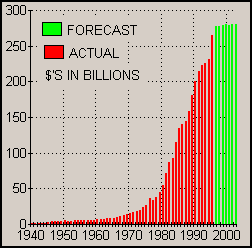
Figure I, below, portrays the dizzying upward spiral of just INTEREST on the National Debt over recent years and projects its continued increase on the basis of substantiated government figures. In a sense, this Figure visually summarizes the effect of continued deficitary defense and trade-imbalance 'bail-out' spending, PLUS our increased Social Security obligations into the next century.
Interest on the U.S. National Debt
FIGURE I
Although it may not be graphically clear, the amounts quoted are in hundreds of billions of dollars and have begun to escalate visibly since the 1980s, i.e. since the Reagan years. Smith bases his suppositions on figures and data generally available from Congressional records and has used a simple mathematical model to project the upward curve into the Twenty-First Century. This is the disturbing picture which alarms many economists who, realizing that both Social Security expenses and on-going budgetary deficits are currently, and for the foreseeable future, the major contributing factors to the National Debt. In the years prior to the collapse of the Soviet Union, the Cold War and the Arms Race contributed to these projections, but have since become a comparatively minor component of calculations now being projected.
The figures being assigned in trillions to this indebtedness dilemma, as well as those in the billions when referring to the annual U.S. Federal Budget, should not be interpreted independently of many other factors. Clearly, we can discount the recent remarks of President Clinton who, for transparent political reasons, claims that his budget is now"balanced", when, in reality, it is not (according to Professor Williams at George Mason University, among others). But even if President Clinton is exaggerating somewhat, many economists feel that the "real deficit" is still not disproportionate to the nation's ability to absorb. When considering the vast productivity of the United States, and its improving balance of trade position in the world, the National Debt - although nothing which should, from an ethical standpoint, be left to our grandchildren to confront - falls realistically within acceptable parameters. The private sector, Japan and, to a lesser degree, the European Economic Community are presently shouldering this debt in the form of Treasury Bonds and various medium and long term instruments. Their solvency depends on the ability of the United States to honor these bonds and/or to make suitable interest payments prior to maturity of the instruments in question. Major Central Banks of Europe and Asia (Taiwan, Japan, Singapore and Hong Kong obviously cannot be omitted from the list of creditor nations vis-a-vis the United States), as well as internal private banks, are floating this debt at present, and seem content to do so, aware that it does not represent an onerous burden for the dynamic American economy.
As Congress and the American people approve forthcoming budgets, annually and with a broader view toward total national indebtedness, they will continue to exercise due caution, and will consult those in positions of authority, notably Alan Greenspan, Chairman of the Federal Reserve, and Deans of the nation's prominent Business Schools, such as Wharton, Harvard, Stanford and Carnegie-Mellon, among others. These consultations, which often occur in Committees and Sub-Committees, result in wise decisions. Conferring with Allies and major power-blocs on the diplomatic front can also stave off hasty or ill-conceived decisions.
Glancing back at the oil-crisis of the 1970s, during which OPEC nations imposed higher price levels on petroleum products, it can be seen that even this major economic shock, causing a momentary dislocation socio-economically, was absorbed by the United States without difficulty. Proper communication between Gulf Nations and the U.S. avoided an even more serious crisis. The same dynamics can be applied to proper management of the internal indebtedness of this country. By consulting with creditor nations, planning, bargaining and competently forecasting, any repercussions which the multi-trillion dollar debt mightseem to cause can be resolved satisfactorily.
Indeed, when the national debt and the budget deficit are placed into proper perspective, with respect to other national objectives, they can be relegated to high priority status, but need not figure among the highest. Unrest in American cities must be dealt with, as must educational goals, health care and projection of a viable U.S. foreign corporate presence. In keeping with "supply-side" economics, it would seem wise to boost economic productivity, create employment and improve the quality of life for the citizenry, rather than to speculate on the wisdom of curtailment of credit and expansion. As the economy expands, the debt decreases proportionately. Of course, the monster of inflation must be held in check through short-term strategies involving the money supply (both M1 and M2) and interest rates; and, importantly, an overall consensus should be reached which provides for growth, dynamism and international cooperation.
Those who speak of chaos and disruption when viewing what they claim to be a spiraling trend in indebtedness, whether short or long term, are themselves short-sighted. When they claim that the United States of America must be run like "the family food budget", they are lapsing into idyllic simplicity. Curiously, even Margaret Thatcher, during the height of her authority in the U.K., realized that she could not run England as she might have her father's grocery store. Conservative though she was, she managed to shore up the welfare structure of all of Great Britain and, at the same time, stabilize the Pound Sterling. She must have conferred frequently with Ronald Reagan, since he performed the same miracle at home, escalating the debt, but ensuring "everyone's" prosperity and well-being.
Nonetheless, it may not be advisable to suggest that Reaganomics are the answer to this question. Times have changed since the 1980s and new strategies must be developed. Attention must be paid to control of the rate of debt increase, both in terms of the budget and the natinal debt, but growth must not be curtailed. Foreign capital must be encouraged to enter the United States and the investment climate must be improved through abatement of restrictive legislation whenever possible. By providing channels for infusion of capital and recycling profits wisely, once generated, indebtedness can be managed, and not entirely on the shoulders of Japan, Europe and the working class of many nations, inclusive of the United States.
In the era of Graham-Rudman, it was politically expedient to provide the illusion of solvency. Now, we must recognize that we can accept modest insolvency in the name of greater prosperity for all. The encouragement of both the internal private sector banks and the external foreign banking community which shoulder the National Debt of the United States seems to point in the direction of optimism. Of course, it is highly profitable for them to absorb this debt, in light of the enormous debt service payments which they receive periodically, but the fact that they were, and are, willing to purchase U.S. Treasury Bonds, in massive amounts, and support the U.S. Currency when required is indication enough of the realistic proportion of this Nation's indebtedness. The United States should feel free to turn its sites toward economic expansion and further enhancement of quality-of-life factors within its boundaries.
REFERENCES
Arnold, R.A. Macroeconomics, Third Edition, West Publishing Company, Minneapolis, 1996.
Rosser, J. B. Comparative Economics in a Transforming World Economy, Irwin, Chicago, 1996.
Smith, Thomas H., An Analysis of the National Debt, 1998, http://nationaldebt.com