Note: Thirty Footnotes have not been included in this on-line version. However, approximately two-thirds of the original footnotes are available in the abbreviated version of this article published in the April 2001 Proceedings of the International Academy of African Business and Development, accessible in DOC format at:
A Joint Venture of the Algerian Society for Mining Research & Development and Dravo Corporation
Art Madsen, M.Ed., Acting President
A B S T R A C T
The Democratic People's Republic of Algeria had long been the commercial and industrial domain of France, even decades after the Algerian War of Independence. Following the Evian Accords, the commercial primacy of the French had not been challenged in Algeria for nearly twenty years. In the realms of military assistance, technical cooperation and ideology, the Soviet Union and Eastern Bloc nations had enjoyed virtually exclusive rights.
The 70 Million Dollar El Outaya Salt Project, representing, in 1977, one of the earlier American Projects of its type, involved transfer of technology, multilateral cooperation and funding from Western sources, and served as a shining example of U.S.-Algerian cooperation, leading to breakthroughs in other sectors of bilateral relations.
While the road was not always smooth, the impact which the modest American presence had on the Algerian people was significant. This study analyses the mechanisms which made the El Outaya Salt Refinery Project a near model for Third World Development initiatives.
Focus is centered on (a) a brief review of the Algerian salt industry, (b) the Joint Venture entity, ALREM, (c) on-site industrial relations, (d) finance and (e) transfer of technology. This case study familiarizes the business executive, student or third-world development specialist with the principal issues at stake in U.S. / Algerian corporate relations, within the context of construction and financing of a major state-of-the-art facility.
Introduction
The El Outaya Rock Salt Refinery located 15 miles from the perimeter of Biskra, Algeria was designed to produce high-quality, pre-packaged, iodized table salt for European consumption and to augment salt export quotients for the Democratic People's Republic of Algeria. Construction of this installation from 1977 to 1979 was projected to influence local economic activity measurably and provided enhanced stability to the Algerian labor force in the Wilayas of Batna and Biskra. Additionally, transfer of state-of-the-art refining technology from Dravo Corporation, based in Pittsburgh, to the Algerian Salt Industry could be viewed as a commercially strategic accomplishment. Nevertheless, there remained a number of unresolved and problematic issues associated with Algerian salaries, benefits and working conditions, reflecting French Colonial practices, which required rectification within the 1977 to 1979 time frame.
This case-study focuses on the largely positive aspects of technology-transfer, finance and international cooperation among SONAREM (The State-Controlled Mining & Mineral Monopoly), Dravo Corporation, ALREM (The Algerian Society for Mining Research & Development), Dravo Costruttori, and Etablissements Dolleans.
The case examines (a) the primary para-statal and internal administrative structures of the Joint Venture Entity, ALREM, (b) the socio-political, demographic and economic features of the indigenous work-force, (c) the nature and dynamics of project financing, and (d) the implications of technology-transfer to Third World Governments, within the specific context of the El Outaya Project. It is our position that the relative flexibility and efficiency within the Algerian environment were factors which facilitated planning, financing and completion of this Project with only minor disruptions and minimal delay.
In fact, productivity and discipline of the Algerian work force, effective inter-action of American, Algerian, French and Italian participants in this Venture and broad operational parameters extant throughout crucial phases of Project Completion would seem to bode well for further multinational activity within Algeria, subsequent to resolution of current internal dissent.
The Algerian Salt Industry: Central Planning
and International Lending
In 1980, one year subsequent to completion of the El Outaya Refinery, Algeria was ranked fourth in salt production among fifteen Arab nations. Yet, all fifteen Arab nations represented only 1.18% of world salt production. Algeria's salt production has been rising gradually since 1980, yet it can be readily appreciated that neither Algeria, nor the Arab world are significant producers of salt by any standard of measure. Prior to completion of the El Outaya facility, Algeria's production of salt had been even less significant.
SONAREM, the State Mining and Mineral Monopoly, under the leadership of President-Director-General Saidi during the 1977-1979 period, had prepared and submitted to The Presidency a development plan extending over a five-year period. Minerals other than salt were given priority. Zinc, potash, and lead-bearing ores, for example, were featured on a basis more favorable than salt.
It was felt within the leadership of SONAREM, an entity influenced heavily by an astute French-educated Principal Counsellor, that commercially marketable salt was an important export product. Salt refining capacity in the vicinity of El Outaya had been limited to extraction of 97% pure rock-salt from neighboring quarries. The 3% impurity quotient, however, was unacceptable by French standards, and France had denied Algeria access to its domestic table-salt market. On the basis of these considerations, SONAREM granted provisional approval for the allocation of approximately 40 Million 1975 U.S. Dollars, toward construction of a sophisticated salt refinery utilizing contemporary technology. These funds were not solidly anchored at this stage of planning, however, and only preliminary geological studies centered on analysis of raw salt from a variety of quarries were technically authorized. El Outaya, however, was favored from the outset for several practical reasons.
Among primary factors contributing to selection of the Wilaya of Biskra, as a definitive site for the Salt Refinery, were, notably, the availability of skilled mining manpower, a pre-existing salt quarry of relatively high calibre, transport facilities, and the heroic role of local Mouhadjine in the Algerian Revolution. This industrial plant could therefore be construed, in part, as a reaffirmation of the values embraced by the FLN, the victorious revolutionary organization which controlled most major governmental functions throughout Algeria.
The advantages of central planning, a policy adhered to by the FLN under Colonel Boumedienne, include, firstly, the possibility of objectively reviewing all options on a national level, undercutting local political interference, and, secondly, minimizing costs, while maximizing quality. Internal decision-making in Algeria is not subject to public exposure and little is known about the actual factors which resulted in El Outaya being selected as Project Site. It is certain, however, that equal distribution nation-wide of infrastructural assets was among priorities considered, in addition to the more evident factors referred to earlier.
It is known that SONAREM's technical analysts reviewed French salt-refining technology, studied evaporative processes, and examined American state-of-the-art crystallization and re-crystallization methods, privately patented. Ultimately, DRAVO's technical expertise and privately patented salt-conversion processes were selected.
Historically, the late 1970s represented a period of relatively loose credit, of expansion and of infrastructural growth in Less Developed Countries. In fact, for the years 1974 through 1977, Algeria received medium- and long-term bank loans (quoted in 1980 U.S. Dollars) amounting to 600 Million Dollars annually. These funds were non-inclusive of other sources of external revenue, such as Arab League Support, State-to-State Grants or Socialist Bloc Assistance.
At times, because an over-abundance of assistance was available, the primary function of SONAREM planners was to attempt to utilize all of the funding being offered to the Algerian Government. This phenomenon of "over-lending" to Algeria, it has been asserted, was due, in part, to the sympathy the Algerian People had won from the entire world during the Algerian Revolution, an event which essentially triggered the decolonization of Africa.
Beyond the foregoing factor, it is widely acknowledged that transnational banks considered developing nations, inclusive of Algeria, to be ideal clients during the mid 1970s and early 1980s.
The domestic salt industry was neither large, nor crucial to Algeria's GDP or GNP; nonetheless, it was a contributing factor to SONAREM revenues in a minor, yet encouraging sense. The El Outaya project, though microcosmic in the overall picture, served to demonstrate that an American multinational firm, working with an integrated work force comprised of Algerians, French, Italians and Iranians, could survive, meet deadlines and turn a profit in a highly centralized, socialist socio-economic context. Significant for Algeria, as well, was the fact that the El Outaya Plant was the first of its kind in the country to produce pre-packaged, high-grade table salt for European Markets.
Not insignificantly, the prospect of generating hard currency was a distinct factor in SONAREM's decision to proceed.
Lastly, with the El Outaya Refinery, Algeria could claim its product had been produced with technology unrelated to the high volume water-based processes of the former colonizer. The American approach was predicated on a system that did not depend on massive amounts of water to ensure continued viability of the operation.
The Joint Venture Entity: ALREM
Under Algerian Law, no foreign firm, located within national territorial boundaries could be controlled by private individuals or entities. The State was required to enjoy a controlling interest of at least 51%. The Joint Venture vehicle, ALREM, was capitalized internally on this basis, although funds from external sources could flow freely through ALREM for project purposes. Local currency allocations were channeled through ALREM via the Banque Nationale d'Algerie (BNA) and hard currency flowed from the U.S., Italy or France, as required for specific purposes. There were also discretionary funds available in France to the Comptroller/Chief Accountant, a Canadian hired by Dravo, with ALREM's consent, largely on the basis of fluency in French.
At ALREM Headquarters, occupying one floor of a high rise office building on Boulevard Mohammed V in downtown Algiers, the offices of the President Director General, Mr. Abdelaziz Hamaidia, and his staff, were located. Across town, in a semi-industrial, semi-residential sector known as Hussein-Dey, the Technical Offices of ALREM were housed, somewhat less comfortably. The third ALREM site was located in El Outaya, a desert village featuring two telephones, one for the Mayor and one for the Salt Refinery Project. Temperatures here often soared to 126 Degrees Fahrenheit.
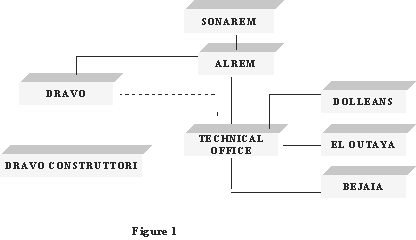
Figure I, below, summarizes the primary relationships and lines of communication within and among the various structural elements involved:
While SONAREM was the client, empowered, as a State-owned entity, to modify its requirements in spite of pre-existing contractual obligations, ALREM was primarily responsible for execution and construction of the Salt Refinery in the eyes of the Government. It had enlisted the expertise, and money, of Dravo Corporation to do so. While some 95% of project credit was being provided by Dravo, control of ongoing activity in-country was formally in the hands of Mr. Hamaidia, President Director General, after consulting with an American executive, who occupied the Number Two position, that of Deputy PDG. Americans, Canadians, Englishmen, Iranians and Algerians worked together under one roof in the Technical Office, sharing facilities and space on an equal footing.
It would be naive to suggest that harmony was the overriding quality which dominated the ALREM hierarchy. Although Mr. Hamaidia and his American Deputy PDG enjoyed a reasonably close relationship, there were constant undercurrents eroding and counter-eroding various power bases within the administrative and technical sectors. A sensational clash occurred in early 1978, when ALREM's Chief Engineer, an American whose background included Dartmouth, challenged a coalition of subordinate engineers, one Iranian, another Algerian, and fell into conflict with his own protector and compatriot, the Deputy PDG. The issue was one of dominance and power in crucial matters concerning project budgeting and scheduling. The administrative alliance, the PDG and his Deputy, sent strong signals to the Engineer who was dispatched to the minor ALREM operation in Bejaia for a brief period of time, then was completely relieved of his functions, having been deemed "a liability" by his own American administrative counterpart. This decision sent shock waves through other Americans working within the Technical Office who were compelled to remain silent under tense circumstances, particularly since many of them had taken the part of the Chief Engineer in this dispute.
The Chief Engineer and his familywere summarily flown back to Pennsylvania and the vacancy remained unfilled, until a British Engineer was ultimately assigned, drawing on American funds for his salary and benefits, to duties in both Algiers and El Outaya.
Examining the internal structure of ALREM, it can be asserted that Dravo-Pittsburgh maintained its autonomy, but acted, in general, through its employees at the technical office in Hussein-Dey. Dravo-Costruttori, the Italian Subsidiary of Dravo Corporation, an independent entity unto itself for financial purposes, provided pre-treated steel for the structural frame of the plant in El Outaya. It was infinitely less expensive to supply steel from Italy than from the United States, thus enhancing potential cost-savings for all concerned, and making the Americans competitive in the eyes of SONAREM, during the initial selection proceedings.
Etablissements Dolleans, a mid-sized construction firm from the South of France, was a sub-contractor (not an integral part of ALREM, as was Dravo) responsible for assembly of the multi-story main processing plant, exclusive of hoppers, duct-work, crystallizing towers, vats and tanks which were the responsibility of Dravo.
Also noted on Figure I is Bejaia, a large city on the Mediterranean Coast, to the East of Algiers, which was the site of an ALREM mini-project, a rock-crushing station where river-run gravel and aggregate were produced.
On-Site Industrial Relations, Manpower
and the Socio-Political Context
While ALREM personnel in Algiers, at both the Headquarters and Technical Offices, were preoccupied with financial, engineering and intraorganizational matters, the work site in El Outaya carried on its day-to-day construction activities, documented bilingually in English and French. Progress was gradual but steady; in 1977 and 1978, attention focused on obtaining cement, heavy-equipment and manpower for the laying of foundations, plus construction of temporary quarters and perimeter fencing. Structural steel was stockpiled and critical preliminary preparations were made.
Work site supervision was ensured by an experienced Englishman, the Project Manager, who reported periodically to ALREM's Deputy Director in Algiers on scheduling, financial requirements, progress and problematic situations as they arose.
Worker payroll was driven physically from Algiers to the work-site. Cash disbursements of the magnitude required were not possible from the Banque Nationale d'Algerie (BNA) located in Biskra. Indeed, frequent shortages of bank notes in Biskra and other outlying towns in the Sahara, such as Touggourt, Ghardaia and Sidi-bel-Abbes, were a banking reality in Algeria where drafts, promissory notes, paper transfers and even bartering were normal transactional modalities.
The El Outaya work force, in initial phases of plant construction, included approximately 250 laborers of varying skill levels. Most of these workers resided in Biskra and commuted in car pool arrangements to El Outaya. Some lived in the village of El Outaya amidst primitive conditions.
Expatriates were housed in a local luxury hotel, the OKBA, later named the Reine des Aures, or had rented modern apartments in the few such buildings that existed in Biskra. Running water was available for two hours daily in Biskra and jerry-cans were filled regularly by hotel personnel for use by guests at other hours.
Because of the hardships of desert life, most workers were inclined to participate conscientiously in Labor Union activities. The UGTA, l'Union Generale des Travailleurs Algeriens, was the governmentally approved Labor Syndicate, representing all levels and categories of workers throughout the nation. Under a theocratic socialist government, labor constituted a privileged force, enjoying a broad panoply of entitlements, benefits, guarantees and severance provisions. Unlike the dictatorial regimes of many former African Colonies, Algeria's political and socio-philosophical luminaries -- Ahmed Ben Bella, Frantz Fanon, Assia Djebbar -- had foreseen the need for the most liberal protections and rights possible. In a nation with vast natural gas and petroleum reserves, it was realistic to provide adequate coverage for all Algerians.
While base salaries were low by U.S. standards, health care, housing subsidies and fringe benefits were all associated, directly or indirectly, with the UGTA's influential programs favoring workers.
It took a certain period of time for Dravo personnel to adjust to the notion of providing six months' unearned salary when terminating employees, paying fathers for time spent with children, or providing legal fees in certain instances for employees, not to mention vast settlements from company coffers for work-related accidents or incidents.
Another feature which required adjustment on the part of American personnel was the system of training Algerian workers, at all levels, to assume the responsibilities of their expatriate counter-parts. As is often the case within the context of infrastructrual projects in the Less Developed Countries, the El Outaya contract called for all foreign personnel to train one or more Algerians in skills -- be they administrative, technical, trade-oriented or professional -- which they were performing during the construction phase. This program worked quite well, except that trainees were often government-appointed students whose families were well-connected. Those assimilating skills under the auspices of ALREM were, in other words, not always the most talented or promising candidates for certain professions or careers.
Algerian Manpower Resources, according to the latest census figures, in the "mining and quarrying" sector included 46,981 men and 1,508 women in recent years. Given a demographic trend toward growth in North Africa, it can be postulated that these figures were somewhat lower in the 1977 time frame, but well within proportions required for the then extant mining industry. Labor, in short, was in abundant supply, and funds were flowing without delay, both locally and from overseas credit sources.
On-site relations between labor and management were cordial, strained occasionally by an incident or two each month. On one occasion in 1978, a young man, one of whose eyes had been seriously injured in an on-site welding accident, became an emotion-filled point of reference among UGTA delegates and Alrem Management. Because Algerian Labor Law was unclear as to whether a trip to France for purposes of ophthalmological surgery was authorized, management ultimately collected funds from all expatriate employees on site and arranged a medical trip to France for the Algerian worker. However, during the negotiation process, emotions ran high and, although everyone was well-intentioned, care had to be taken not to establish an unwieldy precedent in such matters. That the worker was extremely personable and well-liked seemed to have been the deciding factor in this instance.
Knowing that the UGTA could protect their interests most effectively, there was a tendency, however, for some workers, supervisory personnel and crew leaders to deliberately provoke mini-crises, to the displeasure of the Project Manager. He and his on-site accountant, both British, had adapted quite readily to prevailing labor legislation in the country and complied meticulously with all aspects of the Law. If the situation required mediation at higher levels, the PDG of ALREM was contacted and pressure was applied, not only from the UGTA's perspective, but from both sides of the equation. Mr. Hamaidia was well connected in Party circles and "arrangements" favorable to the Project could be made.
On balance, it is fair to state that the UGTA adhered to Algerian Governmental guidelines during annual negotiations. Naturally, there were attempts to improve base salaries in specific manpower categories which were predicated on French labor practices and policies. Three principal categories existed in Algeria , as throughout much of the French-speaking world. They included the following echelons:
A perhaps predictable phenomenon occurred during negotiations. There was a pronounced tendency for members of the "maitrise" level, who, by virtue of their interpersonal skills, frequently acted as Union Delegates, to bargain assiduously for improvement of their working conditions and benefits, to the exclusion of the lower categories. More than 80% of the El Outaya work force fell into the third category, while upper echelon employees often reaped benefits disproportionate to their productivity.
Management, however, was well aware of this phenomenon and did its best, in a somewhat humanitarian reversal of roles, to protect the less articulate laborers.
A governing principle of the original French-based labor legislation, which, with minor modifications, was still in force throughout Algeria, involved the fundamental notion "avantages acquis restent acquis", that is to say "benefits acquired remain acquired." Salaries could not be rolled-back; benefits could not be curtailed. In conformity with the FLN's vision of Algeria, workers could only progress and the quality of life could only rise for all.
Algerian social life was occasionally disrupted by the intensity of the work underway on-site in El Outaya. The UGTA was well aware of individual workers who had to remain away from their families for considerable periods of time, since commuting from outlying areas was impractical.
On one dramatic occasion, a Dolleans employee drove an expectant mother, who had been residing temporarily in the small village of El Outaya to be close to her husband's work-site, to the hospital in Biskra. She arrived just in time to deliver a baby that, traditionally, should have been born in its permanent home town over 200 kilometers away.
An effort was made, eventually, to stabilize the work force, drawing from local manpower resources to minimize hardship. Islamic Holy Days were scrupulously honored and, understandably, productivity fell perceptibly during Ramadhan when fasting from sunrise to sunset was mandatory. In Algiers, as at El Outaya, disputes and short-tempers were characteristic of this lengthy fasting period.
However, relations were generally cordial, and the Head UGTA Representative often attended company social functions.
Algeria in the late 1970s was blossoming industrially, with major natural gas pipelines and production facilities in Hassi-Messaoud, for example, and modern manufacturing plants in areas along the coast such as Annaba, Cherchell and Oran. Under an authoritarian government, it was not possible to explore the possible negative effects of this colossal growth. And, in any event, Algerians were pleased to have jobs, to see their productivity increase and their standard of living improve, particularly after having been suppressed economically under French rule.
Given these circumstances, the delicate flora and fauna of the Sahara were not taken into consideration during construction of the El Outaya Salt Refinery. In retrospect, the habitat of roving herds of camels, of smaller creatures such as the fennec and of desert birds, such as the white doves at which tourists marvelled, could have been adversely impacted by construction work, vehicular traffic and other destructive factors associated with industrial effluent and human activity in the area.
Additionally, the most visually impressive of Saharan oases, mentioned in Andre Gide's writings as one of the loveliest spots on earth, lay not more than 20 miles from the fumes of El Outaya.
Dravo, Alrem and Transnational Banking
Project financing was exclusively the domain of ALREM's Director, his Deputy and the Comptroller. Access to material of a confidential nature was limited. However, funding delays came to the attention of most personnel either through internal correspondence or via the noticeable increase in tension within the office environment. Dravo Corporation had prepared basic financing arrangements in Pittsburgh, using its credit facilities interlinked with Mellon Bank and other local sources, but had interacted as well with French Banking interests, inclusive of the Societe Generale, and their Italian Subsidiary's banking network in Milan and Turin. Local disbursements flowed methodically through pressure exerted by SONAREM from time to time if delays occurred. SONAREM, in fact, drew against its accounts to supply project needs in both currencies (Dinars and Dollars), as their capabilities permitted.
Dravo's Executive Vice-President flew into Algiers occasionally to discuss funding with Mr. Hamaidia and to verify on-going accounting practices, which were required to comply with complex international regulations. There were occasions, of course, when the Government of Algeria did not remit funds on schedule; however, debt service obligations and other commitments were ultimately honored. During these periods of uncertainty, it was normal procedure to call upon the resources of the Parent Company in Pittsburgh in order to maintain flow of project activity on site.
Dravo Corporation had had considerable experience in Algeria, notably within the context of the El Abed Zinc Mine facility alluded to earlier.
Company executives had accumulated a number of contacts within high Government circles who could ensure payment on outstanding indebtedness, as required. Unlike Iraq, Nigeria and Zaire, Algeria was a relatively sound investment, due to the sense of integrity of its officials, and the availability of capital from mineral resources, properly managed.
Dravo Executives frequently arrived in Algiers to market their Corporation's diverse capabilities. Often, after a brief series of meetings with SONATRACH, SONATOUR or SONAREM officials, one executive would be left behind to pursue potential leads in more depth, providing information and liaison services between promising Algerian contacts and Dravo's Pittsburgh office. In spite of considerable experience in the Third World, Dravo occasionally assigned an inappropriately briefed or linguistically incompetent individual to perform these pre-marketing functions.
Due to the extremely delicate quality of trans-cultural negotiations, major errors in judgement were often committed, creating ill-feeling among both Americans and Algerians. This was the case of an Ivy League marketing specialist whose schoolboy French was just dangerous enough to get him into deep trouble. He was "redeemed" by Alrem's Translator to the extent that DRAVO's image was not tarnished. However, the Ivy Leaguer himself was declared "persona non grata" and given 48 hours to depart Algeria. He had played an aggressive ball game of attempting to dictate prices and conditions in a nation which, only a few short years before, had fought one of the most vicious wars of liberation on record. Clearly, Algerians prided themselves on their autonomy and sovereignty.
Focusing briefly on investment terms under Boumedienne's Government, any capital that Dravo Corporation put forward, ostensibly "at risk", was guaranteed against expropriation; indeed, liquidation of the joint venture was highly unlikely, particularly since it was in Algeria's interest that the project proceed unperturbed.
As is the case in most socialist countries, joint ventures must obtain their capital (either through earnings or loan-agreements) in hard currency markets and, hopefully, balance their hard currency expenditures against sufficient export revenue. Applying this formula to a construction project, of course, does not result in immediate revenue and the "balancing" must be deferred until, in this instance, salt sales offset construction costs. Dravo's profits, therefore, were built into the financing made available during, or toward the end of the construction phase. Algeria reimbursed transnational banks after the fact, i.e. subsequent to commencement of salt production and export activity.
El Outaya was constructed prior to the U.S. Trade and Tariffs Act of 1984 which modified the playing field somewhat. Dravo had considerable latitude in determining the terms and modalities of its involvement in Algeria. The parameters of negotiation may have been different after 1984.
In 1982, Third World indebtedness reached crisis proportions and lending diminished. Algeria was fortunate in that it had benefited quite liberally from prevailing conditions prior to the debt crisis. Thereafter, it was one of the nations which continued to receive assistance while other developing nations experienced a dearth of credit. This was partially due to French business interests and influence in major money centers.
Transnational banks were pleased with Algeria's record and performance. El Outaya funding and financing clearly enhanced, in the view of the financial community, the image of a nation desirous of expanding and prospering.
Transfer of Salt Refining Technology to the Government of Algeria
Dravo Corporation, a firm which recently down-sized many of its operations, was a highly technological enterprize, specializing in chemical processes, of course, but also in shipbuilding and large scale construction activity. During the late 1970s, there was an intensity of research within Dravo resulting in development and perfection of sophisticated chemical processes, among them further research on salt refining processes.
The question to be determined is: to what extent was Dravo willing to share this technology with Algeria, for what price and under what restrictive licensing or regulatory conditions? The greater the "exclusivity" of technology, the less likely it would seem that a firm, such as Dravo, would be willing to part with it. This was very much an issue under consideration during the early stages of project planning. SONAREM was convinced that American salt technology was far more adapted to its needs than French technology in use at the time. Because salt is not considered strategically critical, the U.S. Government imposed no restriction on the export of an essentially innocuous process to Algeria. Dravo simply set a price, bound SONAREM to certain resale clauses restricting "wholesale publication" of the process, and agreed to share this know-how with a Third World Government which had shown an interest in its expertise, and with a State-Owned entity, SONAREM, that had been generous in the past with respect to previous Dravo operations on Algerian soil.
Serving as motivation to release technology was also the prospect of government funding. Some of the loans or grants made available to Algeria through U.S. transnational banks represented U.S. government assistance, possibly related to "tied-aid" which was becoming a prominent modality in government foreign aid programs under both Republican and Democratic Administrations. Dravo may simply have been one of several firms availing themselves of this type of financing during the period under analysis.
Indeed, Dravo Corporation had every interest in establishing a firmly-anchored bridgehead in Algeria. It would be naive not to state that the U.S. Government was also eager to enhance the American presence in a nation which had been leaning quite heavily toward the Socialist Bloc, militarily, commercially, and ideologically. It could be asserted that Dravo's "salt technology" was a form of bait or incentive for expanding U.S. influence, or intelligence operations, in a land which had been historically cool to the United States, a nation which, from the perspective of many Algerian intellectuals, had passively "allowed" France to colonize and exploit their homeland for 150 years.
The element of "after-sales" servicing, in addition to the prospect of doing further business with Algeria may have motivated Dravo to remain flexible with respect to its privately developed technology.
Export of high-tech processes and equipment spurs commercial activity and exposes entire populations to American expertise, methods and attitudes. In this age of competitive and nationalistic spirit, it is important to participate in each contest, whether in the developed or developing world. These were only a few of the guiding principles (profit among them, as well, of course) which induced Dravo to seriously embark on the sharing of "exclusive" technology.
Concluding Observations
On balance, The El Outaya Salt Refinery Project accomplished a number of positive goals. First and foremost, the projection of an American presence into a third world environment where Eastern Bloc and French influence had been dominant was not without significance. That cooperation among several nationalities with conflicting backgrounds, priorities and ideologies was possible is also praiseworthy. Surely, too, the augmenting of SONAREM revenue through exportation of high-quality table salt is an accomplishment of note.
While there were unresolved dilemmas, notably in the field of worker compensation, in spite of Governmental Policies which protected the interests of its citizenry, employment was provided to hundreds of workers, the local economy was stimulated, and a sense of pride imbued the towns of Biskra, El Outaya, El Kantara and Tolga, all of which benefitted, if not exponentially, at least tangibly, from the presence of a major industrial facility in the vicinity, providing employment and hope for the next generation of young people.
Dravo's initial cost estimates were tens of millions of U.S. Dollars below actual costs; however, through astute negotiation and competent bilingual mediation, most of these discrepancies were resolved amicably. It is noteworthy, however, to remark that American firms are not among the most competitive in North Africa, and a panoply of factors, other than cost, determine whether American multinational firms are able to win contracts overseas.
REFERENCES
Basche, J. R. Unusual Foreign Payments: A Survey of the Policies and Practices of U.S. Companies, Conference Board, New York, N.Y., 1976.
Blomstrom, M. Transnational Corporations and Manufacturing Exports from Developing Countries, United Nations Centre on Transnational Corporations, United Nations, New York, N.Y., 1990.
Bourdier, P. Algeria - 1960, Cambridge University Press, Cambridge, 1979.
Bouzar, W. La Culture en Question, SNED, Algiers, 1982.
Culpan, R. Multinational Strategic Alliances, International Business Press, New York, N.Y., 1993.
Ewing, J.S. International Business Management: Readings and Cases, Wadsworth Publishing Co., Belmont, California, 1964.
Hansen, P. Conclusions on Accounting and Reporting by Transnational Corporations: The Intergovernmental Working Group of Experts of International Standards of Accounting and Reporting, United Nations, New York, N.Y., 1988.
Hansen, P. Transnational Banks and the International Debt Crisis U.N. Centre on Transnational Corporations, United Nations, New York, 1991.
Hymer, S. The Multinational Corporation: A Radical Approach, Cambridge University Press, New York, N.Y. 1979.
Jacoby, N.H. Bribery and Extortion in World Business: A Study of Corporate Political Payments Abroad, Macmillan, New York, N.Y., 1977.
Kindleberger, C.P. Multinational Excursions, MIT Press, Cambridge, 1984.
Megateli, A. Petroleum Policies and National Oil Companies, A Comparative Study of Investment Policies with Emphasis on Exploration of SONATRACH (Algeria), NIOC (Iran) and PEMEX (Mexico), Ph.D. Thesis (1978), University of Texas, UniversityMicrofilms, Ann Arbor, 1981.
Wallace, D., Jr. International Regulation of Multinational Corporations, Praeger, New York, N.Y., 1976.
Wallender, H.W. International Transfer of Technology: Sources of Conflict, U.S. Chamber of Commerce, Washington, D.C., 1977.
----------- League of Arab States, General Secretariat, Unified Arab Statistical Abstract, 1980 - 1988.
----------- Centre on Transnational Corporations: TNCs in World Development: Trends & Prospects, Executive Summary, United Nations, New York, N.Y., 1988.
U.S. GOVERNMENT DOCUMENT
---------- The Crisis in Algeria, U.S. Committee on Foreign Affairs, African Subcommittee Report, March 22, 1994, Doc. Y4F76/1:AL3/2. (Doc. Fiche)